

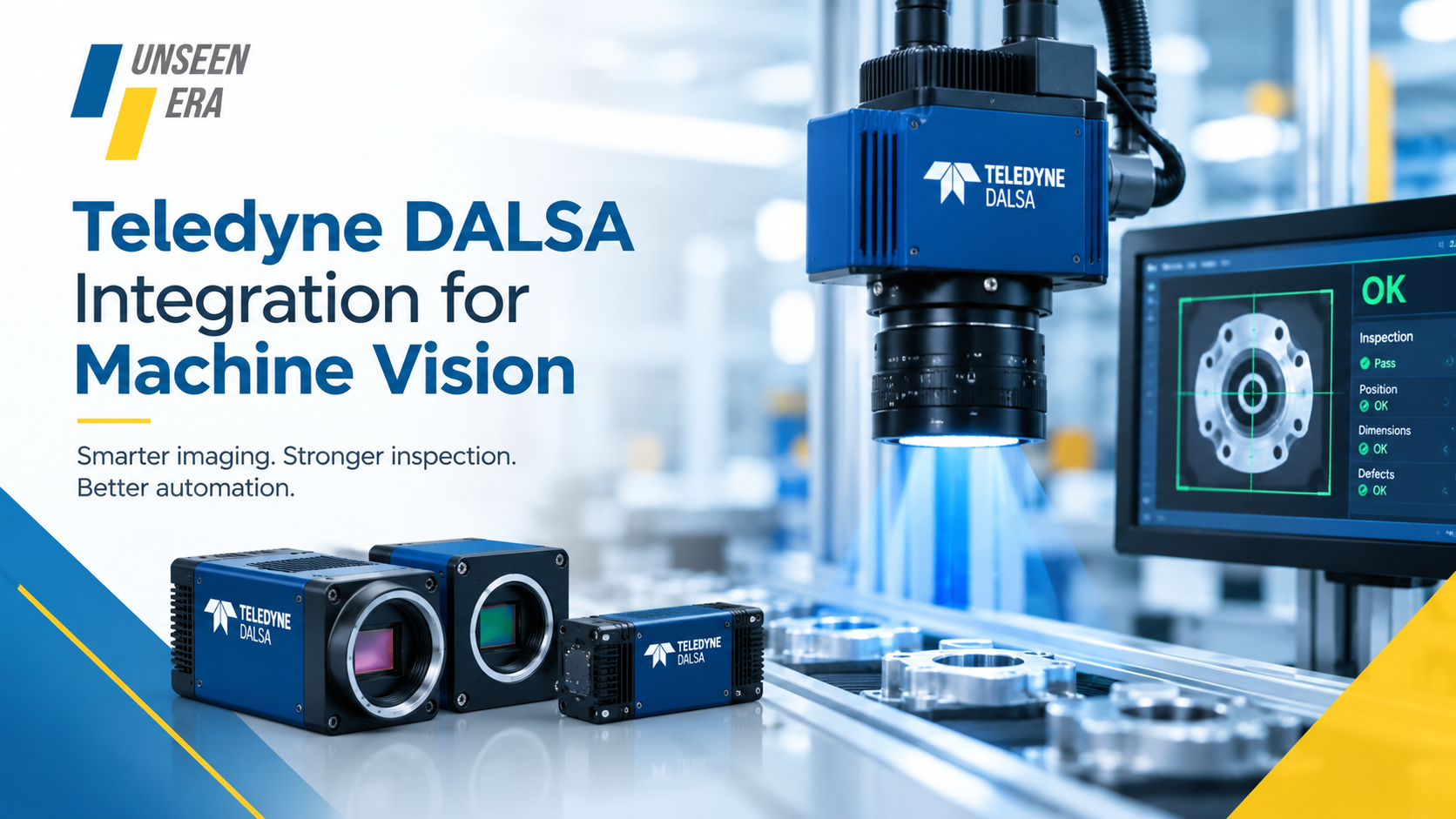
Many of today’s manufacturing and industrial automation applications rely on machine vision systems to screen products, detect defects, measure components, and automate quality control. But it’s not enough just to add a camera. Good integration is the key to building a successful vision solution using well-matched cameras, lenses, lighting, image processing, software, and automation equipment.
If integrated correctly, Teledyne DALSA vision modules can facilitate high data rate image acquisition and analysis, and provide auto-inspection and data-driven decisions in real-time. Furthermore, your solution can be tailored for your production needs and can be used for applications in sectors including automotive, electronics, pharmaceuticals, packaging, food processing, and manufacturing.
Unseen Era Technologies Pvt. Ltd. offers a variety of machine vision integration services tailored to meet individual industrial needs. Whether it is choosing the right imaging sensors and equipment or integrating the system into a machine or control systems, Unseen Era Technologies Pvt. Ltd. strives to deliver appropriate, scalable solutions for inspection and production. You can get us in touch with us +91-7206-86-5596 and mail us on info@unseenera.com.
What is Teledyne DALSA Integration for Machine Vision Systems?
Teledyne DALSA Integration for Machine Vision Systems refers to the process of incorporating Teledyne DALSA imaging technologies into an industrial vision setup to perform automated inspection, measurement, identification, and quality control. Rather than operating as an isolated camera system, the imaging hardware is integrated with other components such as lenses, lighting, image-processing software, computers, PLCs, sensors, and automated machinery.
What Components Are Used in Teledyne DALSA Machine Vision Integration?
The hardware and software components of a Teledyne DALSA machine vision integration can take many forms but often involve several components working together to accurately capture and analyze an image. Key components include:
1. Teledyne DALSA Industrial Cameras
The main visual information capture element in a machine vision system is the camera. Businesses need either area-scan or line-scan cameras for the application.
2. Machine Vision Lenses
Lenses influence the perspective and dimension of inspection. The choice of lens depends on the working distance, field of view, size of the sensor, and the detail in the image.
3. Machine Vision Lighting
Lighting is a critical factor that can be used to accentuate certain defects, edges, shapes, markings, and features. Many lighting options exist, including backlighting, ring lights, bar lights, coaxial lights, and many more lighting options.
4. Image Acquisition and Processing Hardware
The new images must then be transmitted and processed in our system architecture, either using frame grabbers, industrial computers, processing hardware, or other image acquisition equipment that will send the image data captured by the camera to the processing environment.
5. Vision Software
Machine vision software analyzes the images taken and runs the inspection logic. It can be used for defect detection, dimension measurement, pattern matching, reading barcodes, character reading, and product verification.
6. PLCs and Automation Interfaces
PLCs, sensors, robots, conveyors, and other machinery are standard interfaces to most machine vision systems.
7. Sensors and Triggering Devices
Objects can be detected entering the inspection zone, and image acquisition can be triggered at the right time with sensors. Photoelectric sensors, proximity sensors, encoders, and other triggers may be used depending on the production environment.
How Does Teledyne DALSA Integration Work in Machine Vision Systems?
Integrating Teledyne DALSA Products for Machine Vision: Connect Imaging Devices, Optics, Lighting, Software, and Automation Components to Build an Inspection System. For the most part, an integration solution might follow these steps:
1. Understanding the Inspection Requirement
Start by defining what you will be looking at and what you need the system to see or measure. Characteristics such as product size, defect types, production rate, accuracy requirements, and inspection environment can all influence the choice of machine vision.
2. Camera and Imaging Equipment
Images from the ideal Teledyne DALSA camera, or combination of cameras, are chosen based on the imaging needs of the application.
3. Configuring Lenses and Lighting
Once working distance, field of view, and level of image detail required are known, the camera is selected with an appropriate lens. Lighting is set up to reveal prominent features of the product without glare, shadows, reflections, or extraneous deviations.
4. Connecting Image Acquisition and Processing
When the imaging aspects are settled, the camera is connected to the proper processing environment. Pictures are acquired and processed, and the positioning is tailored to the quantity of information and inspection speed needed.
5. Developing the Vision Inspection Workflow
The vision software is used to perform a test on the captured images according to an established set of inspection requirements.
What Applications Can Use Teledyne DALSA Machine Vision Systems?
Teledyne DALSA machine vision solutions can be integrated into factory systems for production lines where automatic image capture, inspection, measurement, identification, and quality verification are required. Some typical applications are:
1. Automated Quality Inspection
Machine vision systems provide inspection of products on the conveyor. Product appearance, quality of assembly, surface condition, and any other criterion predetermined by quality inspection can be determined without the need for manual inspection.
2. Defect Detection
Vision systems can be set up to detect defects including cracks, scratches, dents, missing features, contamination, and other surface defects.
3. Dimensional Measurement
Machine vision can measure components and products without making physical contact. This could be used to measure things like length, width, diameter, position, location, gaps and other dimensional features to specifications.
4. Barcode and Code Reading
Vision systems based on Teledyne DALSA can be used to identify and trace products. They are able to read barcodes, 2D codes, and other markings that allow knowing each product’s origin and content, as well as being able to automate a production line.
5. OCR and Character Verification
Optical character recognition (OCR) is used to read out information that is marked or printed, for instance, batch numbers, serial numbers, dates, and product codes.
Why Choose Unseen Era Technologies Pvt. Ltd. for Teledyne DALSA Integration?
Unseen Era Technologies Pvt. Ltd. builds machine vision integration solutions based on the demands of individual applications.
-
Application-Focused Machine Vision Solutions
Because of the flexibility in the design, Unseen Era Technologies Pvt. Ltd. can propose machine vision applications based on real inspection needs, not an ‘all-in-one’ configuration.
-
Integration With Industrial Automation
Another common application of a machine vision system is to connect with PLCs, sensors, conveyors, robots, and other factory automation hardware.
-
Selection of Suitable Imaging Components
Various applications call for different configurations of resolution, frame rate, field of view, illumination, and optical configuration. Unseen Era Technologies Pvt. Ltd. assists your business in designing a vision solution that uses a Teledyne DALSA camera.
-
Customized Inspection Workflows
All manufacturing processes have a unique set of inspection requirements. A vision system can be used to perform vision applications such as defect detection, dimension measuring, product verification, quality checking, and more.
Frequently Asked Questions (FAQs)
- What is Teledyne DALSA Integration for Machine Vision Systems?
Teledyne DALSA integrates Teledyne DALSA cameras and imaging engines with lenses, lighting, software, processing, sensors, PLC, and automation equipment.
- What equipment is necessary to integrate Teledyne DALSA machine vision?
A standard system might have a Teledyne DALSA camera, machine vision lens, suitable lighting, image acquisition and processing equipment, vision software, sensors, industrial communication and automation equipment.
- In which industries are Teledyne DALSA’s machine vision systems used?
Teledyne DALSA-based vision systems include automotive, electronics, pharmaceutical, food and beverage, packaging, manufacturing, and medical.
- What is the role of Teledyne DALSA integration in automating inspection?
An integrated vision system is capable of automatically taking a picture based on a set of inspection criteria. This may allow for greater product inspection, automatic defect detection, dimensional measurements, code reading, and inspection results sent to production equipment.
- What should a business know before implementing a Teledyne DALSA vision system?
Other critical factors are the inspection needs, production rate, desired image resolution, field of view, depth of field, and integration with current automation equipment.



 Call
 Whatsapp
 Shop Online